(I apologize for how long it has taken me to post this.)
Last month, we had a really great discussion on Max Brooks' World War Z: An Oral History of the Zombie War at Teavolve. Teavolve gave us a great table, great service and amazing food and drink (seriously, their tea-infused sangria is to die for). Be sure to check them out if you can.
Please note that this post may include spoilers, and please be aware of that as you continue to read.
The general consensus of our group was that World War Z was awesome, and that seemed to be an expected reaction even before we picked up the book. Unlike Open City (which we read in June), there has been a lot of chatter - including an upcoming major motion picture - about this book. Because of this book (and his other, The Zombie Survival Guide), Max Brooks has now been widely-considered a zombie expert. We did discuss that Max Brooks brings the zombies in from a more contemporary view (a view that seems to be largely credited to Romero) in which zombies are bred from a virus, rather than the "old" view of necromancy. In discussing this, we realized that is one of the reasons that our society seems to fear zombies so much; it is a possible and present danger.
Despite our ever-growing fear of zombies, they were not the only antagonist in this novel. Society really poses the largest threat to itself, constantly blurring the line between killing itself off and saving itself. Brooks' writing style is a non-traditional one, as the historical fiction novel is a chronological compilation of interviews of people (both well-known people and laymen) who lived through and survived the zombie war. This style was well-received by the book club. In fact, most members said that its structure was the strength of the book and that it became more realistic ("less fantasy") as we got to know all of the characters and their individual stories and personalities. Amanda said that, in hindsight, "it had to be written that way to accomplish the arc of the story."
Brooks really works toward a realistic war. We had two US Army veterans at the discussion and they both talked about how well-researched the weaponry was, as well as the authenticity of the soldiers' actions and reactions. A lot of the warfare was flatly taken from World War II, possibly because that was the last time that the entire world was at war. The difference this time is that everyone has the same opponent, and that opponent is unlike any that has been seen before. As Anthony pointed out, in the past, the goal was to disable your opponent, but in the zombie war it was about completely wiping out the opponent. This draws the question whether this was a real war, or if it was a natural disaster of sorts.
Even after one finishes the book, the war is still fairly ambiguous, in the sense of who accomplished what and who came up with certain ideas first. Brooks does this to give a more realistic view of war, in which even the allies are unsure of how things really played out. The only issue that the book club members seemed to take with this is that his writing, even when portraying speakers of diverse backgrounds, seems to be extremely Westernized. In the end, the American army comes in and makes the final push to end the war ("like all war movies," said Stephanie). The Americans seemed "more civil" and "more humane" than the other countries, who were sacrificing one another and generally acting heartless to those around them when chaos erupted. This was rejected by the members as we all seemed to agree that in a zombie apocalypse, it is more likely that everyone would have to be heartless to a degree in order to survive.
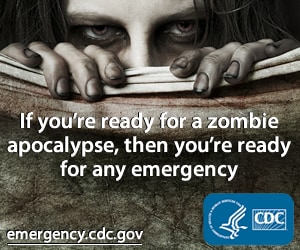
Of course, after reading this book, we are all prompted with the idea that this is possible and the question of how we would handle this is inevitable. Even the Center for Disease Control (CDC) has a webpage called "Preparedness 101: Zombie Apocalypse."
The main concerns that our book club members expressed were: individual
fitness level at time of outbreak, over-vaccinations that either cause
the outbreak or impede our immunity, lack of provisions, and the lack of
"the grid" (or not being able to use the Internet, phones, etc. to get
information and contact others).
In all, we really enjoyed the novel, but do not look forward to the movie. After reading the book and seeing how it is structured, it seems that the movie will either completed deconstruct the book or make a poor replication on screen. We may still take a field trip to see it when it comes out, so keep an eye out for that. Thanks again to all that came to the August discussion. If you read the book and were unable to make the meeting (or if you were at the meeting and have more to add), please feel free to continue the conversation in the comments.
I look forward to August's discussion!
Thursday, August 9, 2012
Friday, August 3, 2012
August - Book Pick & Date
Thank you again to all that came out for July's discussion. I am currently traveling and left my notes on the meeting at home, but I'll type them up early next week for the whole world to see, read, and comment on.
The next meeting is actually going to be more of a field trip to the 'burbs for an awesome beer and wine festival in addition to our discussion. Mark your calendars for August 26th at Blob's Park for the Kegs & Corks Festival. If you are planning to come, I would quickly head over to Groupon and pick up the deal that they have for Kegs & Corks; it'll save you a lot of money on the festival admission fee. For the book discussion, we will meet on Sunday, August 26 at noon. We will discuss the book first in a quiet area of the festival grounds and then see what the festival has to offer! If you plan to go with us in August, please RSVP on Facebook here. If you need a ride or someone to "buddy up" with for the Groupon, please let me know or post on the book club's Facebook page and we'll try to make it happen.
I will post discussion questions by August 20th on here, so please keep an eye out for that. Feel free to contact me on here or Facebook with any questions or comments.
Thanks for your continuous support for Bookmarks & Barstools!
Saturday, July 28, 2012
Choose your own Adventure - August book edition
Good evening! Thanks to all of you who came out to July's discussion; it was a great time. I will be posting about our meeting later this weekend, so keep an eye out for that.
For now, I'd really like to put out the poll for August's book, so everyone can get a start. The poll will close at midnight on July 31. Here are the contenders, in no particular order (all summaries have been pulled from Amazon). Please respond to the poll at the end.

The Book Thief by Markus Zusak
It’s just a small story really, about among other things: a girl, some words, an accordionist, some fanatical Germans, a Jewish fist-fighter, and quite a lot of thievery. . . .
Set during World War II in Germany, Markus Zusak’s groundbreaking new novel is the story of Liesel Meminger, a foster girl living outside of Munich. Liesel scratches out a meager existence for herself by stealing when she encounters something she can’t resist–books. With the help of her accordion-playing foster father, she learns to read and shares her stolen books with her neighbors during bombing raids as well as with the Jewish man hidden in her basement before he is marched to Dachau.
This is an unforgettable story about the ability of books to feed the soul.
Bossypants by Tina Fey
Before Liz Lemon, before "Weekend Update," before "Sarah Palin," Tina Fey was just a young girl with a dream: a recurring stress dream that she was being chased through a local airport by her middle-school gym teacher. She also had a dream that one day she would be a comedian on TV.
She has seen both these dreams come true.
At last, Tina Fey's story can be told. From her youthful days as a vicious nerd to her tour of duty on Saturday Night Live; from her passionately halfhearted pursuit of physical beauty to her life as a mother eating things off the floor; from her one-sided college romance to her nearly fatal honeymoon -- from the beginning of this paragraph to this final sentence.
Tina Fey reveals all, and proves what we've all suspected: you're no one until someone calls you bossy.
Ticking is the Bomb: A Memoir by Nick Flynn
In 2007, during the months before Nick Flynn’s daughter’s birth, his growing outrage and obsession with torture, exacerbated by the Abu Ghraib photographs, led him to Istanbul to meet some of the Iraqi men depicted in those photos. Haunted by a history of addiction, a relationship with his unsteady father, and a longing to connect with his mother who committed suicide, Flynn artfully interweaves in this memoir passages from his childhood, his relationships with women, and his growing obsession—a questioning of terror, torture, and the political crimes we can neither see nor understand in post-9/11 American life. The time bomb of the title becomes an unlikely metaphor and vehicle for exploring the fears and joys of becoming a father. Here is a memoir of profound self-discovery—of being lost and found, of painful family memories and losses, of the need to run from love, and of the ability to embrace it again.
Life of Pi by Yann Martel
The son of a zookeeper, Pi Patel has an encyclopedic knowledge of animal behavior and a fervent love of stories. When Pi is sixteen, his family emigrates from India to North America aboard a Japanese cargo ship, along with their zoo animals bound for new homes.
The ship sinks. Pi finds himself alone in a lifeboat, his only companions a hyena, an orangutan, a wounded zebra, and Richard Parker, a 450-pound Bengal tiger. Soon the tiger has dispatched all but Pi, whose fear, knowledge, and cunning allow him to coexist with Richard Parker for 227 days while lost at sea. When they finally reach the coast of Mexico, Richard Parker flees to the jungle, never to be seen again. The Japanese authorities who interrogate Pi refuse to believe his story and press him to tell them "the truth." After hours of coercion, Pi tells a second story, a story much less fantastical, much more conventional--but is it more true?
Please click on the survey here to respond to your pick for August: http://www.surveymonkey.com/s/BH9QZNC
Thank you!
For now, I'd really like to put out the poll for August's book, so everyone can get a start. The poll will close at midnight on July 31. Here are the contenders, in no particular order (all summaries have been pulled from Amazon). Please respond to the poll at the end.
The Book Thief by Markus Zusak
It’s just a small story really, about among other things: a girl, some words, an accordionist, some fanatical Germans, a Jewish fist-fighter, and quite a lot of thievery. . . .
Set during World War II in Germany, Markus Zusak’s groundbreaking new novel is the story of Liesel Meminger, a foster girl living outside of Munich. Liesel scratches out a meager existence for herself by stealing when she encounters something she can’t resist–books. With the help of her accordion-playing foster father, she learns to read and shares her stolen books with her neighbors during bombing raids as well as with the Jewish man hidden in her basement before he is marched to Dachau.
This is an unforgettable story about the ability of books to feed the soul.
Before Liz Lemon, before "Weekend Update," before "Sarah Palin," Tina Fey was just a young girl with a dream: a recurring stress dream that she was being chased through a local airport by her middle-school gym teacher. She also had a dream that one day she would be a comedian on TV.
She has seen both these dreams come true.
At last, Tina Fey's story can be told. From her youthful days as a vicious nerd to her tour of duty on Saturday Night Live; from her passionately halfhearted pursuit of physical beauty to her life as a mother eating things off the floor; from her one-sided college romance to her nearly fatal honeymoon -- from the beginning of this paragraph to this final sentence.
Tina Fey reveals all, and proves what we've all suspected: you're no one until someone calls you bossy.
In 2007, during the months before Nick Flynn’s daughter’s birth, his growing outrage and obsession with torture, exacerbated by the Abu Ghraib photographs, led him to Istanbul to meet some of the Iraqi men depicted in those photos. Haunted by a history of addiction, a relationship with his unsteady father, and a longing to connect with his mother who committed suicide, Flynn artfully interweaves in this memoir passages from his childhood, his relationships with women, and his growing obsession—a questioning of terror, torture, and the political crimes we can neither see nor understand in post-9/11 American life. The time bomb of the title becomes an unlikely metaphor and vehicle for exploring the fears and joys of becoming a father. Here is a memoir of profound self-discovery—of being lost and found, of painful family memories and losses, of the need to run from love, and of the ability to embrace it again.
The son of a zookeeper, Pi Patel has an encyclopedic knowledge of animal behavior and a fervent love of stories. When Pi is sixteen, his family emigrates from India to North America aboard a Japanese cargo ship, along with their zoo animals bound for new homes.
The ship sinks. Pi finds himself alone in a lifeboat, his only companions a hyena, an orangutan, a wounded zebra, and Richard Parker, a 450-pound Bengal tiger. Soon the tiger has dispatched all but Pi, whose fear, knowledge, and cunning allow him to coexist with Richard Parker for 227 days while lost at sea. When they finally reach the coast of Mexico, Richard Parker flees to the jungle, never to be seen again. The Japanese authorities who interrogate Pi refuse to believe his story and press him to tell them "the truth." After hours of coercion, Pi tells a second story, a story much less fantastical, much more conventional--but is it more true?
Please click on the survey here to respond to your pick for August: http://www.surveymonkey.com/s/BH9QZNC
Thank you!
Monday, July 23, 2012
July Discussion - Questions
Good afternoon readers!
As promised, I am posting some questions to begin discussion for the meeting this weekend. I hope this begins some reflection and analysis. Please come with additional questions if you have them! Also, remember to RSVP as soon as you can, so I can give Teavolve an accurate number. Remember, we will vote on dates/location/book for August at the July meeting.
Questions for Discussion
1. What were you expecting of the book before you picked it up? Did it meet your expectations?
2. What did you think of the non-traditional writing style? Does it lend to the story or distract from the story?
3. How does this compare to other zombie stories that have recently come out (in books, film, etc.)? Brooks makes a nod to Romero at the end of the book. Do you think his story is written in Romero’s style?
4. Would you consider the zombies to be the main antagonist? As Sadie has already asked on Facebook: who was the protagonist?
5. How well do you think the social commentary (infectious disease, wide-spread panic, government mistrust) was presented?
6. Were there any vignettes that stuck out for you? In contrast, were there any that you could have done without?
7. This book is currently being made into a movie and it is supposed to take place during the outbreak, rather than ten years later. Your thoughts on this?
Thank you so much and I look forward to seeing you all on Saturday.
Tuesday, July 3, 2012
July - Book Pick & Date
I'd like to thank those of you who were able to make it to the June meeting & I can't wait for the July meeting!

Mark your calendars for July 28th at 4pm. This time we will be hosting at Teavolve (1401 Aliceanna Street). They have always been very welcoming to events/meet-ups that I have hosted in the past, and this time I expect no different. They have happy hour prices starting at 4pm (until 8pm) and amazing food.
We had 25 responses on the poll for July's book. Thanks for voting! The book that you chose for July is World War Z: An Oral History of the Zombie War by Max Brooks. Check out the summary on this post. You can purchase World War Z at local bookstores (check out our friends over at Atomic Books!), on Amazon, or check it out from the Enoch Pratt Free Library.
I hope to hear back from all of you. Check out the event on Facebook and make sure to RSVP so I have realistic numbers to provide to Teavolve.
I also want to discuss suggestions for the book club. At the last meeting, it was suggested to have questions ahead of time before the meeting; I will be sure to post a few questions by July 23rd, and you can add some as well to the post. I was also thinking that, because we have nine book suggestions this month, we can start having themed months (popular fiction, memoir, classics, sci-fi, etc.). It will cut back on book competition and everyone can feel as if their favorite genre is included. Keep the suggestions coming, I am very excited to see where Bookmarks & Barstools can go.
Thanks for making this book club a success!

Mark your calendars for July 28th at 4pm. This time we will be hosting at Teavolve (1401 Aliceanna Street). They have always been very welcoming to events/meet-ups that I have hosted in the past, and this time I expect no different. They have happy hour prices starting at 4pm (until 8pm) and amazing food.
We had 25 responses on the poll for July's book. Thanks for voting! The book that you chose for July is World War Z: An Oral History of the Zombie War by Max Brooks. Check out the summary on this post. You can purchase World War Z at local bookstores (check out our friends over at Atomic Books!), on Amazon, or check it out from the Enoch Pratt Free Library.I hope to hear back from all of you. Check out the event on Facebook and make sure to RSVP so I have realistic numbers to provide to Teavolve.
I also want to discuss suggestions for the book club. At the last meeting, it was suggested to have questions ahead of time before the meeting; I will be sure to post a few questions by July 23rd, and you can add some as well to the post. I was also thinking that, because we have nine book suggestions this month, we can start having themed months (popular fiction, memoir, classics, sci-fi, etc.). It will cut back on book competition and everyone can feel as if their favorite genre is included. Keep the suggestions coming, I am very excited to see where Bookmarks & Barstools can go.
Thanks for making this book club a success!
Saturday, June 30, 2012
Choose your own Adventure - July book edition
At the June meeting, there were too many ideas that we decided to take it to the Internet and let all of you that weren't able to make this meeting decide for July. Here are the contenders (all summaries have been pulled from Amazon). Please respond to the poll at the end.
Bossypants by Tina Fey
Before Liz Lemon, before "Weekend Update," before "Sarah Palin," Tina Fey was just a young girl with a dream: a recurring stress dream that she was being chased through a local airport by her middle-school gym teacher. She also had a dream that one day she would be a comedian on TV.
She has seen both these dreams come true.
At last, Tina Fey's story can be told. From her youthful days as a vicious nerd to her tour of duty on Saturday Night Live; from her passionately halfhearted pursuit of physical beauty to her life as a mother eating things off the floor; from her one-sided college romance to her nearly fatal honeymoon -- from the beginning of this paragraph to this final sentence.
Tina Fey reveals all, and proves what we've all suspected: you're no one until someone calls you bossy.
World War Z: An Oral History of the Zombie War by Max Brooks
“The end was near.” —Voices from the Zombie War
The Zombie War came unthinkably close to eradicating humanity. Max Brooks, driven by the urgency of preserving the acid-etched first-hand experiences of the survivors from those apocalyptic years, traveled across the United States of America and throughout the world, from decimated cities that once teemed with upwards of thirty million souls to the most remote and inhospitable areas of the planet. He recorded the testimony of men, women, and sometimes children who came face-to-face with the living, or at least the undead, hell of that dreadful time. World War Z is the result. Never before have we had access to a document that so powerfully conveys the depth of fear and horror, and also the ineradicable spirit of resistance, that gripped human society through the plague years.
Wonder Boys: A Novel by Michael Chabon
A modern classic, now in a welcome new edition, Wonder Boys firmly established Michael Chabon as a force to be reckoned with in American fiction. At once a deft parody of the American fame factory and a piercing portrait of young and old desire, this novel introduces two unforgettable characters: Grady Tripp, a former publishing prodigy now lost in a fog of pot and passion and stalled in the midst of his endless second book, and Grady’s student, James Leer, a budding writer obsessed with Hollywood self-destruction and struggling with his own searching heart. All those who love Michael Chabon’s The Yiddish Policemen’s Union and his Pulitzer Prize-winning The Amazing Adventures of Kavalier and Clay will find the same elegant imagination, bold humor, and undeniable warmth at work in Wonder Boys.
Sacre Bleu: A Comedy d'Art by Christopher Moore
In July 1890, Vincent van Gogh went into a cornfield and shot himself. Or did he? Why would an artist at the height of his creative powers attempt to take his own life . . . and then walk a mile to a doctor's house for help? Who was the crooked little "color man" Vincent had claimed was stalking him across France? And why had the painter recently become deathly afraid of a certain shade of blue?
These are just a few of the questions confronting Vincent's friends—baker-turned-painter Lucien Lessard and bon vivant Henri Toulouse-Lautrec—who vow to discover the truth about van Gogh's untimely death. Their quest will lead them on a surreal odyssey and brothel-crawl deep into the art world of late nineteenth-century Paris.
Oh lÀ lÀ, quelle surprise, and zut alors! A delectable confection of intrigue, passion, and art history—with cancan girls, baguettes, and fine French cognac thrown in for good measure—SacrÉ Bleu is another masterpiece of wit and wonder from the one, the only, Christopher Moore.
The Cat's Table by Michael Ondaatje
In the early 1950s, an eleven-year-old boy in Colombo boards a ship bound for England. At mealtimes he is seated at the “cat’s table”—as far from the Captain’s Table as can be—with a ragtag group of “insignificant” adults and two other boys, Cassius and Ramadhin. As the ship makes its way across the Indian Ocean, through the Suez Canal, into the Mediterranean, the boys tumble from one adventure to another, bursting all over the place like freed mercury. But there are other diversions as well: one man talks with them about jazz and women, another opens the door to the world of literature. The narrator’s elusive, beautiful cousin Emily becomes his confidante, allowing him to see himself “with a distant eye” for the first time, and to feel the first stirring of desire. Another Cat’s Table denizen, the shadowy Miss Lasqueti, is perhaps more than what she seems. And very late every night, the boys spy on a shackled prisoner, his crime and his fate a galvanizing mystery that will haunt them forever.
Ticking is the Bomb: A Memoir by Nick Flynn
In 2007, during the months before Nick Flynn’s daughter’s birth, his growing outrage and obsession with torture, exacerbated by the Abu Ghraib photographs, led him to Istanbul to meet some of the Iraqi men depicted in those photos. Haunted by a history of addiction, a relationship with his unsteady father, and a longing to connect with his mother who committed suicide, Flynn artfully interweaves in this memoir passages from his childhood, his relationships with women, and his growing obsession—a questioning of terror, torture, and the political crimes we can neither see nor understand in post-9/11 American life. The time bomb of the title becomes an unlikely metaphor and vehicle for exploring the fears and joys of becoming a father. Here is a memoir of profound self-discovery—of being lost and found, of painful family memories and losses, of the need to run from love, and of the ability to embrace it again.
First Comes Love by Marion Winik
When Marion Winik fell in love with Tony Heubach during a wild Mardi Gras in New Orleans, her friends shook their heads. For starters, she was straight and he was gay. But Marion and Tony's impossible love turned out to be true enough to produce a marriage and two beautiful sons, true enough to weather drug addiction, sexual betrayal, and the AIDS that would kill Tony at the age of thirty-seven, twelve years after they met.
In a memoir heartbreaking and hilarious by turns, Marion Winik tells a story that is all more powerful for the way in which it defies easy judgments. As it charts the trajectory of a marriage so impossible that it became inevitable, First Comes Love reminds us—poignantly indelibly—that every story is a special case.
In One Person: A Novel by John Irving
A compelling novel of desire, secrecy, and sexual identity, In One Person is a story of unfulfilled love—tormented, funny, and affecting—and an impassioned embrace of our sexual differences. Billy, the bisexual narrator and main character of In One Person, tells the tragicomic story (lasting more than half a century) of his life as a “sexual suspect,” a phrase first used by John Irving in 1978 in his landmark novel of “terminal cases,” The World According to Garp.
His most political novel since The Cider House Rules and A Prayer for Owen Meany, John Irving’s In One Person is a poignant tribute to Billy’s friends and lovers—a theatrical cast of characters who defy category and convention. Not least, In One Person is an intimate and unforgettable portrait of the solitariness of a bisexual man who is dedicated to making himself “worthwhile.”
Please vote here ( http://www.surveymonkey.com/s/NGDKMP6 ) for your July book!
Recap: Open City by Teju Cole
We had a small group meet up at Alewife today for the discussion of Open City by Teju Cole. We had a very rich discussion about the book, characters, and literary devices that Cole employs (as well as delicious food & beer!).
Please note that this post may include spoilers, and please be aware of that as you continue to read.
Open City definitely disarmed the group of us, as it is a much "heavier" read than one would expect for 259 pages. The book is written from the perspective of Julian, the main character, and is made up of mostly inner dialogue. The outside dialogue and interaction that does take place is written as Julian perceives it, and therefore prompts the question of the credibility of these stories. Historically, during wartime, an open city was one that, instead of fighting and defending themselves, laid their weapons down and conceded to occupation in order to avoid further violence and bombing. The idea of an open city (in this historical sense, and even in the literal definition of the words), provides an apt notion for what is to come in the novel.
Stephanie made a great point in the beginning of our discussion that most people in our society are reading for a linear storyline, which this novel doesn't provide upfront. This book is more of a read for "aimless wandering." Once the reader feels this, the book is a much more welcoming read. The writing is also something to overcome. The writing itself is beautiful and poetic. There are many instances, as Sadie pointed out, that the language can pull you in ("I lay in bed, too tired to release myself from wakefulness," p. 6). However, as the character progresses throughout the novel, the reader feels pushed away because of the overwhelming pretension, whether or not it is intended that way by Cole.
Julian is a character that the readers feel both an affinity for, and disgusted by (and everything in between). Julian, a Nigerian psychiatrist living in New York City, seems to be depressed and socially removed. Stephanie pointed out that it doesn't seem like he participates in his own life. This is shown numerous times throughout the novel, both during a positive experience that he seems to turn sour, and bad experiences that he dissociates from. In the beginning of the novel, Julian is depressed and wandering--literally throughout NYC and figuratively through his own life--to find out where he fits in. As the book progresses, so does apathy toward Julius. He becomes increasingly audacious and, as Rebecca notes, speaks so highly of his own intellect that he alienates the reader.
As the story progresses, Julian becomes less credible, and we learn that he hasn't always been as popular or heroic as he would like us to think. When we learn about the sexual assault on Moji, there was a lot of confusion and anger from the book club. Some of us were trying to understand why he acted (and years later, reacted) in the ways that he did, and some of us were very much upset with him. Our overall perception and feeling of the main character really seemed to shape the way that we feel about the book in general. This begs the question of whether there is any distance between the main character and the author. This is a fictional piece, but because it was written in first-person, it is difficult to differentiate.
The theme of being an "other," as well as maintaining space -- even if this means isolation -- came up a lot in our talk. Julian is an outsider in all aspects of his life: in New York, as an African, and as an intellectual. His vocabulary choices and allusions almost force the reader to treat him as an outsider as well. This suggests that the isolation is Julian's doing (whether consciously or unconsciously). Julian sums it up the best: "the stranger remains strange."
Thank you to all who made it out to the meeting this month, and I look forward to next month (stay tuned for upcoming blog post about July). You are all welcome to post and react on your own to the book. I'd love to keep the conversation moving online as well. Cheers!
Subscribe to:
Posts (Atom)
